Saturday, October 16, 2010

Wallpaper Rocks!

Hi friends! Have ya heard? Wallpaper is back!

Yes, the design industry is again embracing wallpaper-big time! Now that I have struck fear in everyone who has ever dealt with trying to remove the stuff in years past, let me say-the current papers are nothing like the 1970′s versions with bad patterns, colors and evil glue!


There are so many choices out there now for wallpapers. You can either paper an entire room or use it on one accent wall of a room to really add pop. I also love to use it in hallways for interest in a space that it often overlooked in design.

Wallpaper adds a dimension to your space that you won’t achieve from paint. Paper also is a good option for a room that has less than perfect walls. As with everything, wallpaper cost varies tremendously based on quality, pattern, and amount you require.


If your budget is on the slim side but you found a pattern that you love you can frame it as art, or apply it on a drawer front of a side table. With wallpaper it doesn’t have to be all or nothing, and in many cases less really is more.

In my designs I always choose a fabric that I love and base my color scheme from it. When decorating a room with wallpaper I do the same thing. More often than not wallpaper is my jumping off point because often times it is a dominate feature of the room.


      (image via Sarah Richardson)

Depending upon the style of the room I like to paper an accent wall only. This is a great option when you want to add texture and pattern to a room without breaking the bank or making the room to busy feeling.


    (image via House & Home)

Sometimes keeping the rest of the room calm and adding one shot of texture and color is what you are looking for. Framing paper as artwork  is a great option.


          (image via House & Home)

Adding wallpaper to a hallway or a ceiling can add a sense of whimsy and color that would be otherwise unexpected. A personal fave of mine is grass cloth. Grass cloth adds color and texture with a subtle pattern.


      (image via House & Home)


           (image via Apartment Therapy)

You can use a traditional pattern of paper for your room such as these:


            (image via House &Home)
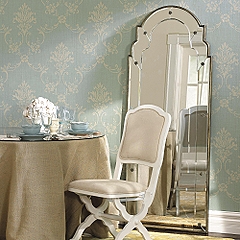


         (image via Ballard Designs)


         (image via Country Living)

or you can decorate outside of the box and bring the great outdoors in


             (Image via Apartment Therapy)

As you can see, wallpaper in decor has never looked better and I hope this post has given you pause to rethink using wallpaper in your decor.

Are you a fan of wallpaper? Have you papered a room recently? What was your experience?

Eco Friendly Flooring Choices

Although many things in design are considered trendy – environmentally friendly is here to stay. We are more informed and educated now regarding how things are being manufactured and disposed of.  What was acceptable practice 25 years ago, in many cases is not acceptable now. As the saying goes, “when we know better we do better”.


A term we are hearing a lot today with reference to interiors, particularly with paints, is low VOC. What does this term mean? VOC  is an acronym for Volatile Organic Compounds. Everything from new furniture to wall coverings all emit toxins into the air that can have a negative effect on our health. Purchasing products with low VOC’s minimizes the compounds that are being released into our environments and ultimately into the air we breathe.


I wanted to write about eco-friendly flooring in this post because quite often when working with clients, flooring is one of the most difficult decisions to make. There are so many different materials, finishes, stains, price points, etc. Although hardwood is a personal favorite of mine the following  materials that I am going to introduce you to rival any hardwood in my book!

Bamboo

Did you know that Bamboo is actually not a wood but a grass? As a result it takes 3-5 years for a bamboo plant to reach full maturity compared to hardwood that takes between 20-120 years! In many cases Bamboo is harvested without the need to replant because the root system is left intact . Bamboo is very comparable to hardwoods with its strength, durability and great looks. It is available in planks from 3″ to 6″ wide, is water-resistant and anti-microbial.


Cork

This type of flooring is made from removing the bark of the cork oak tree. When harvested correctly it will not harm the tree. Cork is naturally anti-microbial, and has excellent heat retention which ensures it is comfortable under foot. Cork flooring is covered with UV resistant acrylic to seal the floor and help prevent fading. Cork although a soft material does “spring back” preventing any imprints in the floor which may occur as a result of furniture being placed on it. Cork is prone to scuff so I do not recommend using it in high traffic areas such as hallways.


Marmoleum

Made from linseed oil, pine resin,wood flour and is jute backed this product is often a go to choice for architects and designers in commercial applications due to its durability and eco-friendliness. Marmoleum comes in a variety of designs and has recently gained popularity with home owners and is used primarily in kitchens and playrooms. It is available in either 1×1 tiles or 2 meter wide sheets that can be cut to your specified length. Marmoleum is biodegradable and boasts a 40 year life span!


Reclaimed Hardwood

Oh be still my heart! Reclaimed hardwood is “harvested” from old barns, factories and century homes. Its naturally distressed patina means it only looks better with age. This flooring is water-resistant, durable and will practically last forever. I can’t think of a more beautiful or unique option than reclaimed wood.

                               (photo sources: apartment therapy,woodfloors.org,teragen.com)

Eco-friendly does not have to be boring or basic. It also does not have to be expensive-prices range on these flooring choices from $ 2 per square ft to $ 13 per square ft uninstalled depending on the option you choose. As we all try to make more conscious choices for ourselves and our families knowing that environmentally friendly flooring choices are widely available and are definitely a good investment for years to come.

What is your take on all that is Eco-friendly? Do you have any of these flooring options in your home? What has been your experience with them?